
In many companies, information about job positions, wages, and compensation policies is scattered across the HR system, payroll software, and various spreadsheets. When it becomes necessary to compare employee compensation or explain a discrepancy, obtaining reliable data can be complicated and time-consuming.
Transparent compensation is not just about the differences between women and men. Job classification, performance evaluations, and a company’s ability to determine wages based on objective criteria are also important.
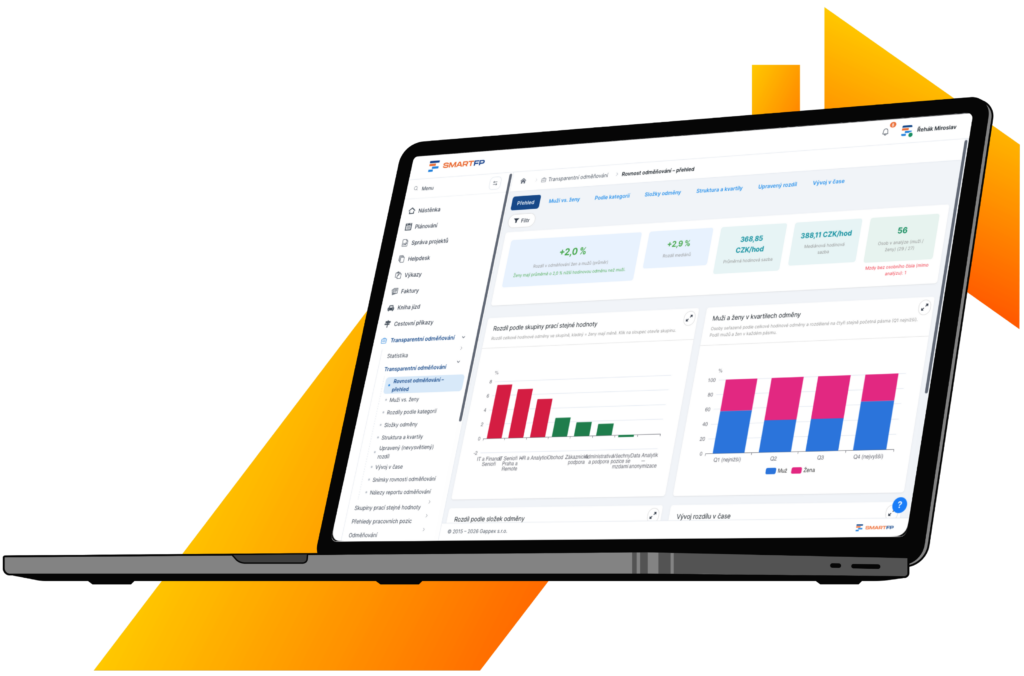
The Transparent Compensation Module in SmartFP integrates job positions, payroll data, compensation classification, and analysis into a single system. It guides the company through each step and helps prepare the necessary documentation to meet new legal requirements.
Summary of this article’s content:
What Is Transparent Compensation?
Transparent compensation means that a company uses clear, objective, and non-discriminatory rules to determine compensation. It can explain the criteria it uses to evaluate individual job positions, how it classifies employees into groups, and why differences in compensation may arise.
The basis for this is European Directive (EU) 2023/970, which strengthens the application of the principle of equal pay for equal work or work of equal value. This principle is already in effect in the Czech Republic under Section 110 of the Labor Code. The new rules are primarily intended to increase transparency and enable employers to better demonstrate the correctness of their procedures.
It is not, therefore, a matter of all employees receiving the same pay. A company must be able to objectively explain why certain jobs are comparable and for what reasons pay may differ.
What new obligations await employers?
The European Directive on Pay Transparency sets forth requirements for clear pay policies, informing employees and job applicants, and assessing pay gaps. The Czech Republic is preparing to incorporate these requirements into the Labor Code.
According to the proposal approved by the government on August 31, 2026, the new rules are expected to take effect on January 1, 2027. Additional disclosure and reporting requirements are to be phased in gradually. However, the final wording and deadlines may change during the legislative process.
The main obligations being prepared include:
- A documented compensation system —clearly defined rules for performance evaluation, employee classification, and compensation determination.
- Job classification —categorizing jobs based on objective criteria and their value.
- Transparency in hiring – providing information about the offered compensation and limiting questions about candidates’ prior salary history.
- Evaluation of pay gaps – comparing compensation across relevant groups and assessing the causes of discrepancies.
- Reporting and disclosure requirements —providing specified information and, for larger employers, regularly reporting pay gaps.
Regular reporting is intended primarily for larger employers. The requirements are to be phased in gradually based on the number of employees and the final version of the Czech legislation.
For a more detailed explanation of the proposed rules, visit Transparent Compensation Legislation.
Why Is It Not Enough to Compare Only Women’s and Men’s Wages?
One of the best-known indicators is the Gender Pay Gap—that is, the difference in pay between women and men. However, the overall difference alone does not explain why it exists or whether it is a justified discrepancy.
To evaluate employees properly, a company also needs to compare employees who perform the same work or work of equal value. In doing so, it takes into account the value of the work, not just the job title.
At what levels can compensation be compared:
- Women and Men – A Comparison of Compensation by Gender.
- Same Job Position —Differences Among Employees Performing the Same Work.
- Same job group —comparison of individuals classified in a comparable group.
- Same job grade – evaluation of compensation within a specific pay grade.
This allows the company to evaluate compensation based on specific criteria, identify unusual discrepancies, and determine which cases require further review.
How to Create Comparable Job Groups?
Proper salary comparison starts with job positions. Every job has a certain level of difficulty, responsibility, and requirements for knowledge or experience. It is precisely these characteristics that are important for objective classification.
Predefined criteria are used in the evaluation. Based on these criteria, job positions can be classified into pay grades, pay ranges can be defined, and groups of jobs of equal value can be created.
In SmartFP, the system links job evaluations to job classifications. Based on the available input data, it can also generate job proposals based on payroll records or group proposals based on predefined point ranges. The company then verifies whether the proposals correspond to the actual job content.
This creates a uniform basis for further analysis. The company does not have to recreate tables and decide which positions can be compared during every evaluation.
How to Prepare Payroll Data for Analysis?
To properly compare compensation, it’s not enough to simply have a list of employees and their base salaries. It’s necessary to take into account work schedules, time periods, other compensation components, and the specific conditions of individual job positions.
For example, it is important to standardizing compensation, which allows different salary data to be converted to a comparable basis. The analysis also takes into account full-time equivalents (FTE) and seniority.
Various components of compensation, such as base pay, bonuses, and allowances, can be included in the analysis. The results can be assessed using the mean and median, which help provide a better understanding of the distribution of wages.
For further analysis, it is also possible to use an adjusted pay gap that takes into account selected relevant characteristics, or a benchmark for additional comparison with the reference market.
An advantage of the system is that available data can be imported and reused for further evaluations. This means the company does not have to prepare the entire analysis from scratch with every salary update.
What to Do When Pay Gaps Are Identified?
A detected pay gap does not automatically constitute discrimination or a violation of the law. It is important to examine its causes and determine whether it is based on objective and non-discriminatory grounds.
Under certain circumstances, differences may be related, for example, to job performance, relevant experience, expertise, responsibilities, or specific working conditions. However, each reason must be objectively assessed and adequately documented.
To systematically manage the results, it is advisable to keep a record of deviations and exceptions, including their justification, approval, and, if applicable, the date of the next review.
During repeated evaluations , a snapshot—which captures the state of the data at a specific point in time and allows for an assessment of its development—can also be helpful.
This provides the company with important information for making compensation decisions and for explaining its approach during an audit, if necessary.
How does SmartFP simplify transparent compensation?
Transparent compensation in SmartFP integrates the entire process—from job design and classification to the analysis of pay gaps and the documentation of their justifications.
The system guides the company step by step through the process. This means the company doesn’t have to design the entire process on its own, painstakingly combine data from multiple spreadsheets, or repeatedly perform the same calculations.
Based on the primary input data, the system also generates proposals for the necessary definitions, such as job positions based on payroll records or groups based on predefined evaluation ranges. The company then reviews these proposals and adjusts them according to its actual compensation practices.
What benefits does the system offer:
- Legislative Readiness – Documentation for New Requirements, from Job Classification to Analysis and Reporting.
- Clear Process – The system guides the company through each step and reduces the need to design the entire process from scratch.
- Automated Definitions – Proposals for job positions and comparable groups based on available data and selected rules.
- Multiple levels of comparison – comparison of compensation by gender, job title, job group, or pay grade.
- Variance analysis – identification of differences and documentation of their possible objective reasons.
- Time savings for HR – recurring calculations and reports are generated in a single environment without the need to constantly create spreadsheets.
- Ongoing adaptation to legislation —the solution can be developed in line with new requirements and their final form.
The main benefit is not merely calculating the pay gap. The company gains insight into its own compensation system and the ability to make decisions based on consistent, traceable data.
For a more detailed step-by-step guide, visit the page How Transparent Compensation Works at SmartFP.
How to Prepare for Transparent Compensation?
It’s worth getting started even before the new rules take effect. The most challenging part is often not the calculation of pay gaps itself, but preparing high-quality input data and correctly setting up job classifications.
Companies should first determine what data they have available, how they define the value of work, and whether they can explain how compensation is determined. Regular analysis can then build on this foundation.
Recommended preparation steps:
- Collect input data —job positions, work schedules, payroll records, and other relevant information.
- Establish evaluation criteria —a common framework for assessing the value of individual jobs.
- Create comparable groups —classify positions into classes and groups according to established rules.
- Evaluate compensation —compare wages and identify significant differences.
- Review and document discrepancies —assess their causes and propose measures as needed.
- Regularly update the results —work with new data and continuously review the established rules.
SmartFP allows you to start with a one-time analysis of the current state or to implement ongoing evaluation. This enables the company to choose a scope that suits its needs and gradually take further steps.
Transparent Compensation as an Opportunity for the Company
Transparent compensation is not just another legal requirement. A properly configured system can provide a company with greater insight into its pay structure, consistent rules, and better data for decision-making.
Instead of repetitive work in spreadsheets, companies can use a single system that links job classifications, salary data, compensation comparisons, and records of the reasons for identified discrepancies.
With SmartFP , a company can save time when evaluating compensation, prepare the necessary documentation for regulatory compliance, and better assess its own compensation decisions.
Want to find out how prepared your company is?
See how the SmartFP system works with job positions, comparable groups, and salary analysis. Schedule a no-obligation demo of the solution.
More Information on Transparent Compensation
Would you like to learn more about this topic? Check out additional SmartFP resources, including an overview of the legislation, an expert interview, and a webinar recording.
Transparent Compensation: What Lies Ahead for Czech Companies and Why They Should Start Now
Webinar: Transparent Compensation
Legislation on Transparent Compensation
Information on the proposed legislation is current as of November 10, 2026. The Czech amendment is currently going through the legislative process, and its final form and effective dates are subject to change.