A Service Desk That Brings Order and Control to Your IT
A single central point for all requests, incidents, and communication. Gain visibility into IT services, speed up response times, and improve the quality of support.

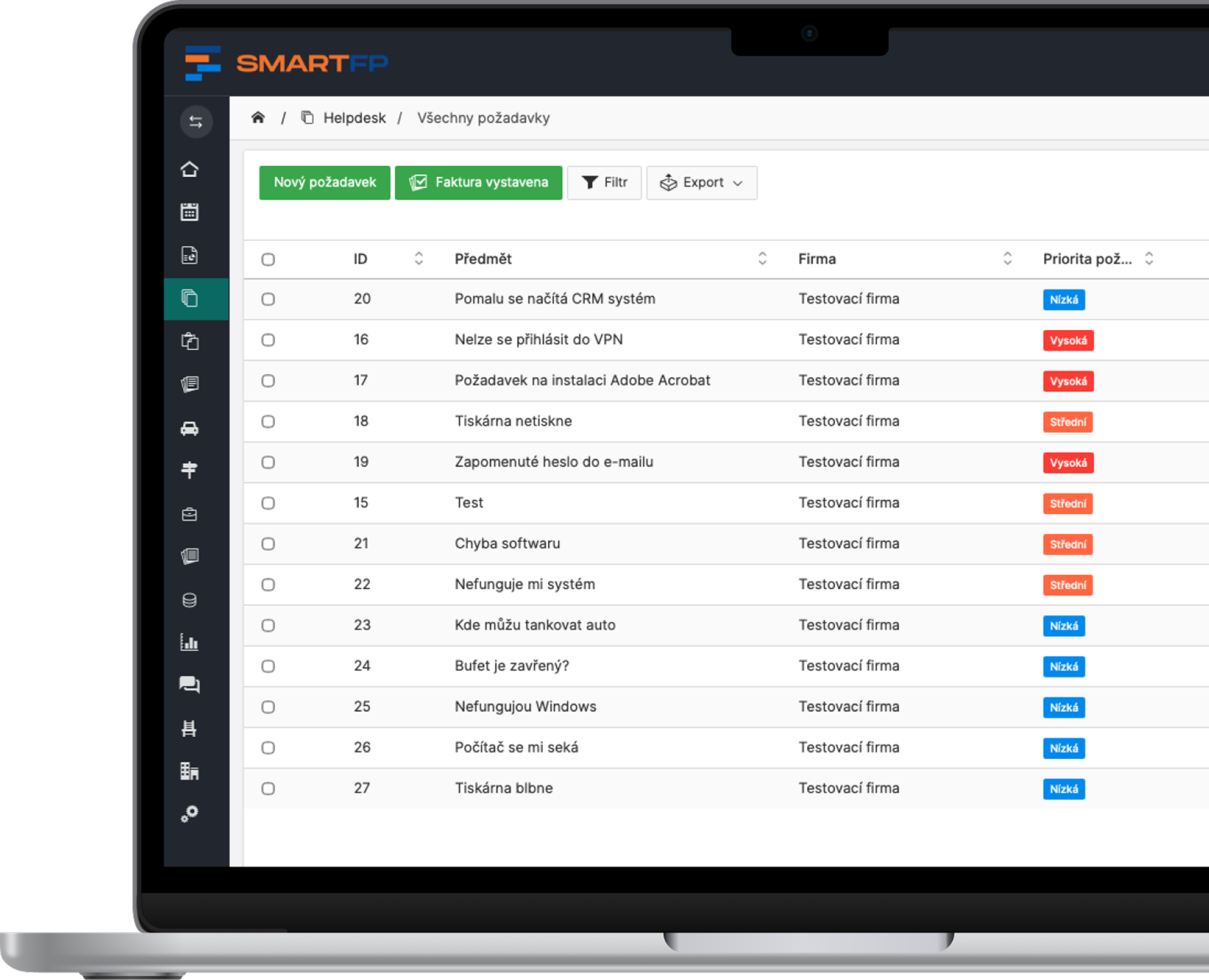






What ServiceDesk Is Handling Today
Comprehensive IT service management in a single system
Requests and Tickets
All requirements clearly in one place
Changes
Controlled IT Change Management
SLA
Monitoring Deadlines and Service Quality
Incidents
Quick Resolution of Outages and Problems
Communication
Everything in a single request
Reporting
IT Support Performance Overview
Problems vs. Solutions
Without a Service Desk, IT support cannot scale
Reality Without a System
Requests end in emails
Users don’t know where to post
Incidents take too long to resolve
The IT team is dealing with chaos instead of priorities
There is a lack of insight into status and performance
With the Service Desk
One place for all your needs
A Clearly Defined Problem-Solving Process
Overview of SLAs and Priorities
Control Over IT Services
Fast incident resolution
Help Desk vs. Service Desk
The help desk handles individual requests and incidents.
It assists users with specific problems and ensures they are resolved quickly.
The Service Desk manages IT services as a whole.
It establishes processes, monitors SLAs, and ensures that IT support operates systematically and efficiently.
Take Control of Your IT Services
Simplify communication, set up processes, and stay on top of what’s happening in your company.

Who Is ServiceDesk For?
ServiceDesk: A Solution for the Entire Company
IT Team
Less chaos, clear priorities
Users
easy communication
Management
data for decision-making
Read our case study
See how SmartFP helps companies digitise their daily agenda in practice.

AAA AUTO has accelerated the resolution of IT requirements thanks
When the original ticketing system is no longer sufficient IT requirements were under control. The problem was that the system that…
Learn how to use SmartFP in minutes
You can customise the system to make it easy to use for everyone. Accountants, receptionists and bosses. On the computer and in the mobile app. Just a few details below. We will contact you and suggest a date for a demonstration, free of charge and without obligation.
FAQ
Your most common questions
Looking for answers to your questions or need help with our system? We’ve put together a list of frequently asked questions where you can find useful information and solutions to common problems. If anything is not clear to you? Send us a question.
What is a Help Desk?
The help desk is a system for tracking and resolving requests, incidents, and communication within the company. It helps ensure that no request is overlooked and that every request is assigned to a specific person to handle it.
What is the difference between a Help Desk and a Service Desk?
The help desk is primarily used to handle requests and incidents.
The Service Desk is a broader concept that encompasses IT service management (ITSM), change management, SLAs, and other processes.
Is the Help Desk only for the IT department?
No. The help desk can be used across the entire company—for IT, HR, operations, facilities, or administration. It handles all types of internal requests.
How do requests enter the system?
Requests can be submitted via email, through a form, or via an internal request. The system automatically converts them into tickets.
Who is ITSM suitable for?
For companies that want to maintain control over their IT services, improve their processes, and enhance the quality of their support.
Will the Help Desk help speed up the resolution of requests?
Yes. Thanks to visibility, automation, and SLAs, both response times and the resolution process itself are accelerated.
What does ITSM stand for?
ITSM (IT Service Management) is an approach to managing IT services within a company. It focuses on the effective provision of support, as well as incident management, change management, and service quality management.
Does SmartFP support ITIL?
Yes. SmartFP supports key ITIL principles, such as incident management, change management, SLAs, and workflow management.