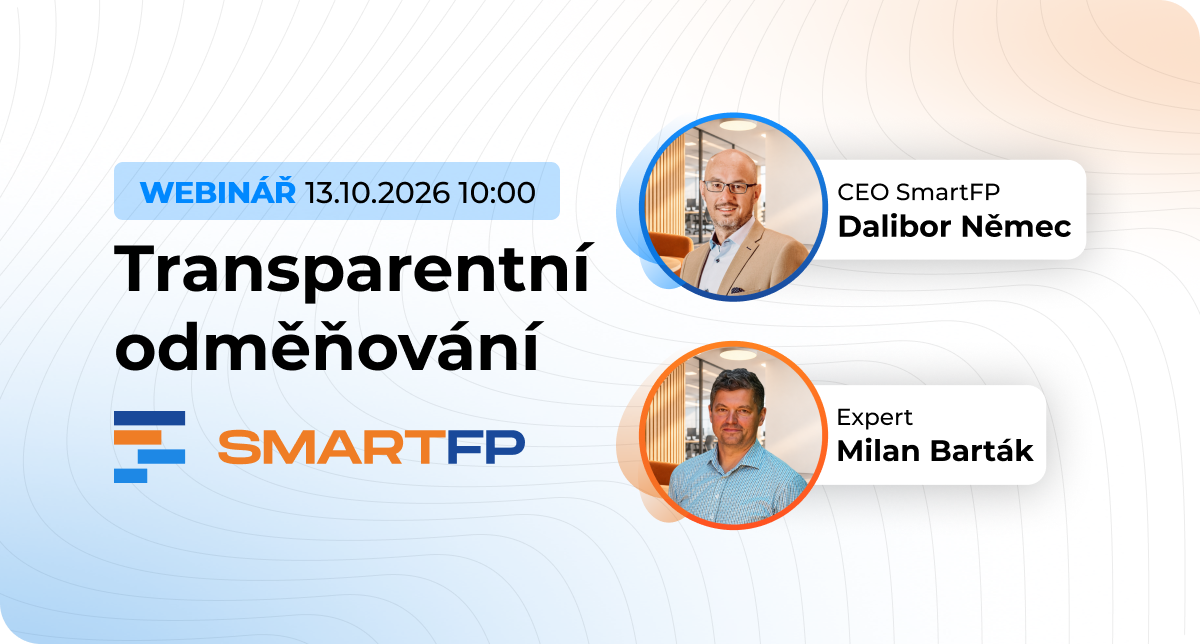
Webinar Recording
Transparent Compensation: What to Expect and How to Approach It
The amendment to the Labor Code will impose new obligations on employers. In this one-hour webinar, expert Milan Barták will walk you through what the change means, and Dalibor Němec from SmartFP will show you what a practical solution might look like. You can watch the recording at any time.
speakers
Who will lead the webinar

Milan Barták
Expert in Transparent Compensation
It helps companies set up compensation systems that will meet the new transparency requirements. It will walk you through what the amendment entails and what you should start addressing right away.

Dalibor Němec
CEO, SmartFP
He leads SmartFP, a low-code platform for business processes. He will demonstrate how to incorporate transparent compensation requirements into day-to-day HR work without spreadsheets or manual lookups.
program
What You’ll Hear in the Recording
First, understand what is changing. Then, see how to handle it in practice. Finally, answers to participants’ questions.
Introduction to the Issue
What the EU directive and the upcoming amendment to the Labor Code entail. Who is affected by the new obligations, when they take effect, and what employers must have in place: groups of jobs of equal value, pay criteria, information for job applicants and employees, and a report on pay disparities.
It is led by Milan Barták, an expert on transparent compensation.
A Real-World Example of a Possible Solution
What a transparent compensation system might look like in practice. We’ll show you how to track job categories and pay ranges, how to use the data to compile a report on pay disparities, and how to respond to an employee who requests information.
Led by Dalibor Němec, SmartFP.
Watch the recording—it’s free
The webinar took place on October 13, 2026. You can watch the full recording, including answers to participants’ questions, right now.
Questions vs. Answers
The pay scales won’t last much longer
Transparent compensation isn’t just about publishing numbers. It’s about having data that can be used to provide answers to employees, job applicants, and the labor inspectorate.
What’s Worrying Employers Today
Who is affected by this, and when does it take effect?
The new rules will affect all employers, though to varying degrees and with different effective dates.
Groups of jobs of equal value
How to divide positions into comparable groups, and according to what criteria.
Salary Range for Applicants
What to Tell a Candidate About Compensation Before the Interview.
Report on Pay Disparities
What data should be used to compile it, and what should be done if there is a discrepancy?
Employee Request for Information
How to respond when an employee asks about the average pay in their job category.
What You’ll Take Away from the Webinar
Overview of Responsibilities and Deadlines
In plain language, without legal jargon, including what is currently just a proposal.
Procedure for Work Groups and Criteria
How to get started, even if you currently use pay scales.
Sample Records and Reporting
What the data, ranges, and discrepancy report might look like in a single system.
Answers to Your Questions
At the end, there will be an opportunity to ask the expert about specific situations at your company.
Presentation Following the Webinar
We will send the materials to all registered participants via email.
Where Does the Legislation Stand Today?
The right to discuss one’s salary takes effect in June 2025. The Ministry of Labor and Social Affairs published the draft transposition amendment in March 2026, and it provides for a deferred effective date. In this webinar, we’ll discuss what is certain and what may still change.
Effective June 2025
: The right to share information about one’s salary (Section 346a)
Starting on the 1st 1. 2027
Most of the new obligations (according to the proposed amendment)
Starting on the 1st 1. 2028
Report on Pay Gaps and the Right to Information (Draft)
Who for?
Who is this webinar intended for?
HR Directors and HR Professionals
They will shoulder the bulk of the new workload.
categories of work and criteria
Information for Applicants
Responses to Employees
Chief Financial Officers and Payroll Departments
They will provide data for the discrepancy report.
data sources for reporting
salary range
impact on the budget
Company Executives and Owners
They are responsible for ensuring that the company fulfills its obligations.
What are the consequences of noncompliance?
How long will the preparation take?
where to start
Compensation Specialists
They want to see how this can be addressed systematically.
group work methodology
Example of Record-Keeping in Practice
Questions for the Expert
Want to get in the mood before the webinar?
Read the interview with Milan Barták about what transparent compensation will change and why you shouldn’t wait for the final version of the law.

Transparent Compensation: What Lies Ahead for Czech Companies and Why
On August 31, 2026, the government approved an amendment to the Labor Code , which transposes the European Directive on…
FAQ
Frequently Asked Questions About the Webinar
Can’t find the answer? Write to us and we’ll get back to you.
Is the webinar really free?
Yes. Just sign up using the link on this page—that’s all you need to do.
How do I sign up?
The webinar is held online. After you register, you’ll receive an email with a link to join, as well as a reminder the day before.
Will I get the presentation?
Yes, we will email the webinar materials to all registered participants after the webinar ends.
Can I ask you something?
Absolutely. You can post your questions in the chat during the webinar; Milan Barták and Dalibor Němec will answer them at the end.
Does this apply to our company as well?
According to the proposed amendment, basic obligations—such as a transparent compensation system or information for job applicants—will apply to all employers. Regular reporting on pay gaps will then apply to companies with 100 or more employees, in accordance with the EU directive. We’ll go over this in detail during the webinar.
Is the webinar linked to SmartFP?
The first part is purely technical and applies to everyone. In the second part, we’ll demonstrate one possible solution in the SmartFP environment so you can see how it works in practice.